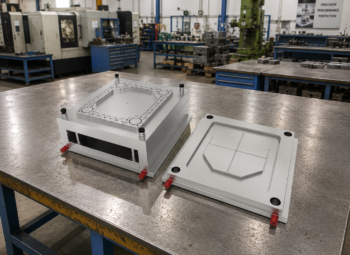


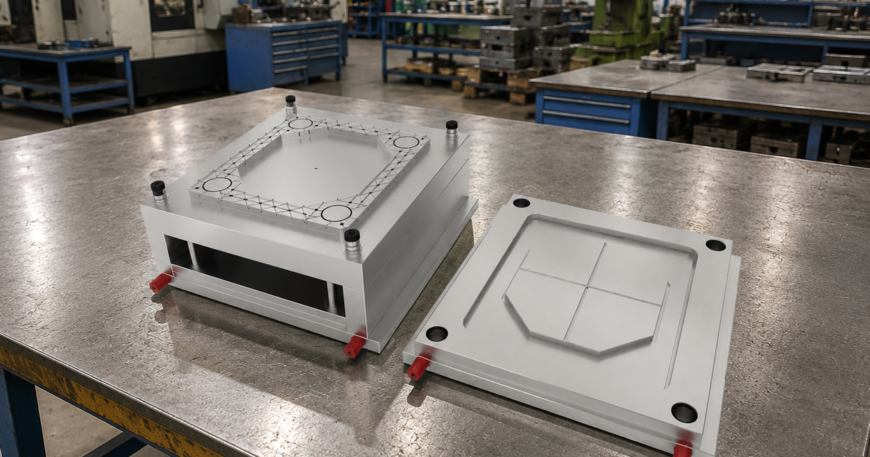
Choosing the right mould is one of the most important decisions in plastic manufacturing. The mould you select can influence product quality, production speed, tooling costs, design flexibility, durability, and ultimately your return on investment. For manufacturers, product designers, and businesses launching new plastic products, the key question is often: Should you choose custom plastic moulds or standard moulds?
The answer depends on your product requirements, production volume, budget, design complexity, and long-term manufacturing goals. This guide explains the differences between custom and standard plastic moulds and helps you determine which option is right for your product.
What Are Custom Plastic Moulds?
Custom plastic moulds are specially designed and manufactured to produce a specific product or component. The mould is developed according to the product’s exact dimensions, shape, material, surface finish, tolerances, and functional requirements.
Custom moulds are commonly used when a product has a unique design or requires features that cannot be achieved efficiently with an off-the-shelf mould.
For example, automotive components, medical devices, electronic housings, industrial parts, consumer products, and specialized packaging often require custom moulding solutions.
Key benefits of custom plastic moulds
- Design flexibility: Manufacturers can create complex shapes, unique geometries, textures, logos, and functional features.
- Precise dimensions: The mould can be engineered to meet specific dimensional tolerances.
- Better product differentiation: A unique mould allows businesses to develop products that stand apart from competitors.
- Material optimization: The mould can be designed around the selected plastic material and its flow characteristics.
- Long-term production value: A durable custom mould can support high-volume production over many production cycles.
The biggest advantage is control. Instead of adapting your product to an existing mould, the mould is designed around your product.
What Are Standard Moulds?
Standard moulds, sometimes called off-the-shelf or conventional moulds, are moulding solutions based on commonly used sizes, shapes, components, or established tooling designs.
They are generally suitable for products with relatively simple and standardized requirements. Because much of the mould design or components may already be available, standard moulds can reduce development time and initial tooling expenses.
Standard moulds can be a practical choice for businesses producing simple components, prototypes, low-risk products, or products where extensive customization is unnecessary.
Key benefits of standard moulds
- Lower initial cost: Existing designs and standardized components can reduce tooling expenses.
- Faster availability: Production can often begin sooner than with completely new tooling.
- Simpler development: Standardized moulding approaches may require less engineering work.
- Suitable for straightforward products: Simple containers, caps, basic components, and other conventional parts may not require highly customized tooling.
However, standard moulds can have limitations when a product requires specific dimensions, intricate features, specialized materials, or a distinctive appearance.
Custom Plastic Moulds vs Standard Moulds: Key Differences
The main difference is flexibility versus simplicity.
| Factor | Custom Plastic Moulds | Standard Moulds |
|---|---|---|
| Design flexibility | Very high | Limited |
| Initial tooling cost | Usually higher | Usually lower |
| Development time | Longer | Usually shorter |
| Product uniqueness | Excellent | Limited |
| Complex geometries | Highly suitable | May be unsuitable |
| Precision requirements | Can be highly customized | Based on standard specifications |
| High-volume production | Excellent | Depends on application |
| Best for | Specialized products | Simple or standardized products |
When Should You Choose Custom Plastic Moulds?
Custom moulding is usually the better choice when your product has unique or demanding requirements.
Your product has a unique design
If your product needs a proprietary shape, detailed surface pattern, branding elements, or complex geometry, a custom mould gives you greater design freedom.
This is especially important for companies that compete through product differentiation.
Precision is critical
Industries such as medical, automotive, electronics, and engineering often require tight tolerances. A custom mould can be engineered around these requirements to achieve consistent production results.
You plan high-volume production
Although custom tooling can require a higher upfront investment, the cost per part can become attractive when the mould is used for large production runs.
A properly engineered mould can improve cycle efficiency, reduce defects, and support consistent output over time.
You need specific material performance
Different plastics behave differently during injection moulding. Factors such as shrinkage, flow, cooling, and temperature requirements need to be considered during mould design.
Custom tooling allows engineers to optimize the mould for the chosen material and production process.
Product appearance matters
If the product requires a particular texture, gloss level, pattern, logo, or cosmetic finish, custom mould design provides greater control over the final appearance.
When Is a Standard Mould the Better Choice?
Standard moulds can be the smarter option when speed, simplicity, and lower initial investment are the priorities.
Your product has a simple design
If the component does not require unusual shapes or tight tolerances, a standard solution may perform perfectly well.
You are testing a market
Startups and businesses launching a new product may want to minimize initial tooling expenditure. A standard approach can sometimes provide a cost-effective way to validate demand before investing in advanced tooling.
Production volume is low
For limited production quantities, the higher upfront investment associated with custom tooling may not be economically justified.
Time-to-market is critical
If you need to start production quickly, an established moulding solution can reduce development time compared with designing and manufacturing a completely new mould.
How Much Do Custom Plastic Moulds Cost?
There is no single price for a custom plastic mould because tooling costs depend on multiple variables.
Important cost factors include:
- Product size and complexity
- Number of cavities
- Mould material and steel grade
- Injection moulding machine requirements
- Required tolerances
- Surface finish
- Cooling system design
- Ejection mechanism
- Expected mould life
- Production volume
- Engineering and design requirements
A basic mould may be considerably less expensive than a complex multi-cavity mould with automated features. Therefore, businesses should evaluate total cost of ownership, rather than comparing only the initial mould price.
Custom Moulds and Long-Term ROI
One of the most important considerations when choosing tooling is return on investment.
A custom mould may cost more initially, but it can deliver better long-term economics when used for large production volumes. Improved cycle times, lower rejection rates, consistent quality, optimized material usage, and reduced manual intervention can all contribute to lower per-unit costs.
For high-volume manufacturing, the right custom mould can become a strategic production asset rather than simply an upfront expense.