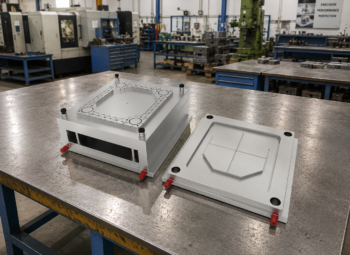


Plastic products are used in almost every industry, from automotive components and electrical products to packaging, consumer goods, medical products and industrial equipment. Behind many of these products is a carefully engineered injection moulding die or mould that determines the product’s shape, dimensions, surface finish and repeatability.
For manufacturers, choosing the right plastic die mould manufacturer is an important decision. A properly designed and manufactured mould can support high-volume production, consistent product quality and efficient cycle times. On the other hand, an incorrectly designed mould can result in flash, sink marks, warpage, short shots, dimensional variation and higher production costs.
This guide explains everything businesses should know about plastic injection moulding dies, including their types, components, manufacturing process, materials, applications, cost factors and how to select a reliable injection moulding die manufacturer.
Whether you are searching for a plastic mould die maker near me, planning a new product, comparing plastic mould die price, or looking for injection molding dies for sale, understanding the fundamentals will help you make a better manufacturing decision.
Table of Contents
ToggleWhat Is an Injection Moulding Die?
An injection moulding die, commonly called an injection mould or injection moulding tool, is a precision-engineered tool used to produce plastic components.
During the injection moulding process, plastic material is heated until it becomes molten. The molten plastic is then injected into the cavity of the mould under controlled pressure. After the material cools and solidifies, the mould opens and the finished component is ejected.
The mould essentially acts as the negative form of the desired product.
A properly designed die for injection molding must account for several factors, including:
- Product geometry
- Plastic material
- Shrinkage
- Wall thickness
- Cooling requirements
- Ejection system
- Injection location
- Surface finish
- Production volume
- Machine specifications
- Required dimensional tolerances
This is why professional plastic injection moulding die makers need both design expertise and precision manufacturing capabilities.
Plastic Die Mould vs Injection Moulding Die
The terms die, mould and tool are sometimes used interchangeably in the plastic manufacturing industry, although technically they can refer to different tooling concepts.
A plastic die mould is generally understood as a tool used to shape plastic material into a specific component or product.
An injection moulding die is specifically associated with the injection moulding process, where molten plastic is injected into a mould cavity.
Depending on the manufacturing process, companies may require:
- Injection moulds
- Blow moulding dies
- Compression moulds
- Insert moulds
- Two-shot moulds
- Multi-cavity moulds
- Prototype moulds
- Production moulds
The appropriate tooling solution depends on the product design and manufacturing method.
Why Is a High-Quality Plastic Injection Mould Important?
The mould has a direct impact on the quality and economics of plastic production.
A professionally manufactured mould can provide:
Consistent Product Dimensions
Precision machining allows manufacturers to maintain dimensional consistency between production cycles.
Better Surface Finish
The cavity surface can be polished, textured or finished according to product requirements.
Improved Production Efficiency
Efficient cooling, gating and ejection systems can help reduce unnecessary cycle time.
Reduced Rejection
Proper mould design can minimize common defects such as flash, warpage, sink marks and short shots.
Longer Tool Life
Appropriate tool steel, heat treatment and manufacturing methods can improve durability.
Better Production Economics
Although precision tooling may require a significant initial investment, a well-designed mould can support large production volumes over its useful life.
Types of Plastic Injection Moulding Dies
There are several types of injection moulding dies used according to product requirements and production volumes.
1. Single-Cavity Injection Mould
A single-cavity mould produces one component per injection cycle.
It can be suitable for:
- Prototypes
- Low-volume production
- Large components
- Initial product validation
- Specialized components
The tooling can be comparatively straightforward because there is only one cavity.
2. Multi-Cavity Injection Mould
A multi-cavity mould contains multiple identical cavities.
For example, a four-cavity mould can produce four components during one injection cycle.
Multi-cavity tooling is commonly considered for high-volume manufacturing because more components can be produced per cycle.
However, the mould design must maintain appropriate balance between cavities and consistent filling.
3. Family Mould
A family mould produces different components within the same mould.
It may be useful when several related components are required, but the design requires careful consideration of filling balance and part characteristics.
4. Two-Plate Mould
A two-plate mould is one of the commonly used injection mould configurations.
Its design is comparatively straightforward and can be suitable for many conventional plastic components.
5. Three-Plate Mould
Three-plate mould designs provide additional flexibility for gating and parting arrangements.
They can be useful where the required gate position or part geometry makes a conventional two-plate design less suitable.
6. Hot Runner Mould
Hot runner systems keep plastic material within heated channels before it enters the mould cavity.
They can reduce cold runner waste and can be advantageous for certain high-volume applications.
However, hot runner systems generally require careful engineering, temperature control and maintenance.
7. Cold Runner Mould
In a cold runner system, the runner material cools along with the moulded part.
Cold runner tooling remains widely used because of its relatively straightforward construction and maintenance.
What Is a Blow Moulding Die?
A blow moulding die or blow mould is used for manufacturing hollow plastic products.
Common examples include:
- Bottles
- Containers
- Tanks
- Industrial hollow components
- Packaging products
- Plastic drums
Unlike conventional injection moulding, blow moulding involves forming a hollow plastic component inside a mould using air pressure.
The choice between an injection mould and a blow moulding die depends on the product design and manufacturing process.
Main Components of an Injection Moulding Die
A modern plastic injection moulding die consists of multiple precision-engineered components.
Mould Cavity
The cavity forms the external shape of the component.
Core
The core forms internal surfaces and features of the product.
Core and Cavity Inserts
Replaceable inserts may be used to simplify maintenance or accommodate complex product features.
Sprue
The sprue provides the initial path through which molten plastic enters the mould system.
Runner
The runner distributes molten plastic toward the cavity or cavities.
Gate
The gate is the controlled entry point through which molten plastic enters the product cavity.
Cooling Channels
Cooling channels circulate a cooling medium through the mould to help control mould temperature and solidification.
Ejector System
After the product has sufficiently cooled, ejector pins or other mechanisms help remove the finished part.
Guide Components
Guide pins and bushes help maintain proper alignment between mould halves.
Mould Plates
Various plates provide structural support and accommodate the mould’s internal components.
Die Making for Injection Moulding: How It Works
Professional die making for injection moulding involves several stages.
Step 1: Product Design
The process starts with the customer’s product design.
CAD data is reviewed for:
- Wall thickness
- Draft angles
- Undercuts
- Ribs
- Bosses
- Tolerances
- Parting line
- Gate position
- Ejection requirements
Design-for-manufacturing principles should be considered at this stage.
Step 2: Mould Design
After reviewing the product, engineers develop the mould design.
The design determines:
- Number of cavities
- Core and cavity arrangement
- Runner system
- Gate type
- Cooling layout
- Ejection system
- Mould base
- Steel selection
- Machine compatibility
Advanced CAD and simulation tools can be used to evaluate filling and cooling behavior before manufacturing.
Step 3: Material Selection
The mould material is selected according to production volume, plastic material and required durability.
Common tool materials include different grades of:
- Tool steel
- Stainless steel
- Pre-hardened steel
- Hardened steel
- Aluminium for selected prototype applications
Material selection directly affects tooling performance and cost.
Step 4: CNC Machining
The mould components are manufactured using precision machining equipment.
CNC machining can produce complex geometries with controlled dimensions.
Depending on the design, additional processes such as milling, drilling, turning and grinding may be required.
Step 5: EDM Machining
Electrical Discharge Machining, or EDM, can be used to create intricate shapes that may be difficult to machine conventionally.
EDM is particularly useful for:
- Deep cavities
- Sharp internal features
- Fine details
- Complex geometries
Step 6: Grinding and Finishing
Precision grinding may be used to achieve required dimensional accuracy and surface quality.
The mould cavity can then receive additional polishing or texturing depending on the final product requirement.
Step 7: Mould Assembly
All individual components are assembled into the completed mould.
Engineers verify:
- Alignment
- Movement
- Ejection
- Cooling connections
- Cavity and core fit
- Runner and gate arrangement
Step 8: Trial and Testing
Before full-scale production, the mould is tested using the intended injection moulding machine and material.
The trial process helps identify potential issues such as:
- Flash
- Short shots
- Sink marks
- Warpage
- Uneven filling
- Ejection problems
- Dimensional variation
Corrections can then be made before production approval.
Moulding Die Manufacturing: Why Precision Matters
Moulding die manufacturing requires precision because even a small dimensional error in the mould can affect the finished plastic component.
Important areas include:
Dimensional Accuracy
The cavity and core must meet the required dimensions and tolerances.
Proper Alignment
Incorrect alignment can cause parting-line mismatch, uneven wear and product defects.
Surface Finish
The cavity surface influences the appearance of the finished product.
Cooling Efficiency
Uneven cooling can contribute to warpage and dimensional instability.
Ejection
The ejection system must remove the component without damaging it.
For these reasons, businesses searching for accurate plastic dies & moulds should evaluate a manufacturer’s design, machining, inspection and testing capabilities rather than selecting a supplier based solely on price.
How Much Does an Injection Molding Die Cost?
One of the most common questions buyers ask is:
What is the injection molding die cost?
There is no single fixed price because mould costs vary considerably depending on design and manufacturing requirements.
The plastic mould die price may depend on:
- Product size
- Product complexity
- Number of cavities
- Tool steel
- Mould base
- Surface finish
- Tolerances
- Cooling system
- Runner system
- Hot runner requirements
- Ejection mechanism
- Number of slides
- Lifespan requirements
- Production quantity
- CNC machining requirements
- EDM requirements
- Testing and modifications
Therefore, a reliable plastic moulding die cost estimate should be prepared after reviewing the product drawing or 3D CAD model.
Factors That Affect Plastic Mould Die Price
Product Complexity
Simple products generally require less complicated tooling than components containing complex ribs, undercuts, threads or moving mechanisms.
Number of Cavities
Increasing the number of cavities usually increases tooling complexity and manufacturing cost.
However, multi-cavity tooling can potentially improve per-part economics for high-volume production.
Material
Tool steel selection affects both cost and expected tool life.
Surface Finish
High-gloss polishing, special textures or decorative surfaces may require additional processes.
Tolerances
Tighter tolerances typically require more precision machining and inspection.
Hot Runner System
Hot runner systems can add significant cost compared with conventional runner arrangements.
Slides and Lifters
Complex side actions require additional components and engineering.
Expected Production Volume
A low-volume prototype mould may have different design priorities from a mould intended for millions of cycles.
How to Get an Accurate Injection Moulding Die Cost Estimate
Instead of requesting a generic price, provide the mould manufacturer with as much technical information as possible.
Useful information includes:
- Product 3D CAD file
- Product 2D drawing
- Plastic material
- Expected production quantity
- Number of cavities desired
- Injection moulding machine details
- Surface finish requirements
- Dimensional tolerances
- Colour requirements
- Expected mould life
This information allows an injection moulding die manufacturer to develop a more realistic quotation.
Choosing an Injection Moulding Die Manufacturer
Choosing the right injection moulding die manufacturer can have a major effect on tooling performance and production efficiency.
Consider the following factors.
1. Engineering Capability
Look for a manufacturer with experience in mould design, DFM and plastic processing.
2. CNC Machining Capability
Precision machining equipment is important for manufacturing accurate mould components.
3. EDM Capability
Complex mould geometries may require EDM.
4. Quality Inspection
Ask how dimensions are inspected and verified.
5. Trial Facility
A manufacturer capable of supporting mould trials can help identify issues before production.
6. Material Knowledge
The manufacturer should understand different tool steels and their applications.
7. Experience With Your Product Type
Experience with similar components can be beneficial, particularly for complex plastic parts.
8. After-Sales Support
Moulds require maintenance and sometimes modifications during their working life.
A supplier offering technical support can simplify long-term tooling management.
Plastic Injection Moulding Die Makers in India
India has a large manufacturing ecosystem supporting plastic processing, engineering, automotive, electrical, packaging and consumer-product industries.
Businesses looking for plastic injection moulding die makers can evaluate manufacturers based on their:
- Engineering facilities
- CNC machinery
- EDM capabilities
- CAD/CAM systems
- Quality control
- Tool steel options
- Trial facilities
- Delivery capabilities
- Maintenance support
Industrial manufacturing hubs across Gujarat, Maharashtra, Tamil Nadu, Karnataka and other regions have companies involved in mould and tooling manufacturing.
For businesses in Gujarat, working with a manufacturer in or near Ahmedabad can also simplify communication, design discussions, inspections and tooling modifications when local support is important.
Searching for a Plastic Mould Die Maker Near Me
Many buyers begin their search with the phrase:
“plastic mould die maker near me.”
Local sourcing can offer practical advantages, including:
- Easier communication
- Faster design discussions
- Physical inspection opportunities
- Easier trial coordination
- Lower travel requirements
- Potentially simpler maintenance support
However, geographic proximity should not be the only selection factor.
A nearby manufacturer without the required technical capabilities may not be suitable for a complex mould.
When comparing local suppliers, evaluate their engineering, machinery, inspection, tooling materials, experience and support capabilities.
Injection Moulding Machine Die: What You Need to Know
An injection moulding machine die must be compatible with the machine on which it will operate.
Important machine parameters include:
- Maximum mould dimensions
- Clamping force
- Tie-bar spacing
- Maximum mould height
- Minimum mould height
- Injection capacity
- Shot size
- Ejection system
- Nozzle dimensions
- Hydraulic/electric interface requirements
A mould designed without considering machine specifications can create compatibility problems.
Therefore, machine details should be shared with the mould manufacturer before finalizing the tool design.
Injection Molding Dies for Sale vs Custom Manufacturing
Some buyers search for injection molding dies for sale because they want an existing mould.
Off-the-shelf or previously manufactured tooling can sometimes be appropriate for standardized applications.
However, most customized plastic components require a dedicated mould designed around the exact product geometry.
A custom mould provides control over:
- Product dimensions
- Gate location
- Cooling design
- Ejection
- Cavity quantity
- Surface finish
- Material selection
- Production requirements
Before purchasing an existing die, verify that its cavity dimensions, mould base, machine compatibility and product requirements match your application.
Common Plastic Materials Used With Injection Moulding
Different plastics have different processing characteristics.
Common materials include:
PP – Polypropylene
Used in packaging, automotive components, household products and industrial parts.
ABS
Often used for products requiring good rigidity, impact resistance and surface appearance.
HDPE
Used in containers, industrial products and various applications requiring durability and chemical resistance.
LDPE
Commonly associated with flexible plastic products.
Nylon / PA
Used in engineering applications where mechanical performance is important.
POM
Used for precision engineering components requiring low friction and dimensional stability.
PC – Polycarbonate
Used where impact resistance and transparency or engineering performance are required.
The mould design should be developed with the selected plastic’s characteristics and shrinkage behavior in mind.
Common Problems With Poorly Designed Plastic Dies
An inexpensive mould can become expensive if it creates ongoing production problems.
Common defects include:
Flash
Excess plastic escapes through unwanted gaps between mould components.
Short Shot
The cavity does not fill completely.
Sink Marks
Depressions can appear on the product surface because of uneven shrinkage.
Warpage
The component may deform because of uneven cooling or internal stresses.
Weld Lines
Flow fronts may meet and create visible or structurally significant lines.
Burn Marks
Trapped air or gases can cause localized burning.
Ejection Marks
Improper ejector positioning or excessive ejection force can damage the component.
Many of these problems can be reduced through proper mould design, processing optimization and testing.
Importance of Cooling System Design
Cooling is one of the most important parts of injection mould design.
After molten plastic enters the cavity, it needs to cool and solidify before the component can be ejected.
An inefficient cooling system can result in:
- Longer cycle times
- Uneven cooling
- Warpage
- Dimensional variation
- Higher production costs
For complex moulds, engineers may evaluate cooling channel placement carefully to improve temperature uniformity.
Importance of Gate Design
The gate determines how molten plastic enters the product cavity.
Gate selection depends on:
- Product geometry
- Material
- Wall thickness
- Appearance
- Flow requirements
- Production volume
- Desired gate location
Common gate types include:
- Edge gate
- Pin gate
- Submarine gate
- Direct gate
- Hot runner gate
A suitable gate design helps achieve consistent filling and can improve the appearance of the finished component.
Maintenance of Plastic Injection Moulding Dies
Even a high-quality mould requires regular maintenance.
Recommended maintenance may include:
- Cleaning mould surfaces
- Checking guide components
- Lubricating moving components
- Inspecting ejector pins
- Cleaning cooling channels
- Checking for corrosion
- Inspecting cavity and core surfaces
- Checking hot runner components
- Monitoring wear
- Replacing damaged components
Proper maintenance can help extend mould service life and reduce unexpected production interruptions.
How Long Does an Injection Mould Last?
Mould life depends on several factors rather than a single fixed number.
Key factors include:
- Tool steel grade
- Plastic material
- Production volume
- Injection pressure
- Mould design
- Maintenance
- Processing conditions
- Corrosive materials
- Surface treatment
- Manufacturing quality
A production mould designed for high-volume manufacturing may use more durable materials and components than a prototype tool.
When discussing tooling with a manufacturer, ask for an expected service-life target based on the proposed material and design.
Applications of Plastic Injection Moulding Dies
Plastic injection moulding dies are used across numerous industries.
Automotive
- Interior components
- Clips
- Covers
- Housings
- Functional components
Electrical & Electronics
- Switch housings
- Connectors
- Enclosures
- Consumer electronics components
Packaging
- Caps
- Closures
- Containers
- Packaging components
Medical
- Housings
- Disposable components
- Laboratory products
Consumer Products
- Household products
- Kitchen components
- Storage products
- Accessories
Industrial Products
- Machine components
- Protective covers
- Fittings
- Technical parts
Why Businesses Choose Custom Plastic Dies & Moulds
Custom tooling provides manufacturers with greater control over the final product.
With accurate plastic dies & moulds, businesses can develop tooling according to their specific:
- Product geometry
- Material
- Production volume
- Machine
- Dimensional requirements
- Surface finish
- Quality expectations
This makes custom mould manufacturing particularly important for proprietary products and components.
Plastic Mould Die Maker: Questions to Ask Before Ordering
Before finalizing an order with a plastic mould die maker, consider asking:
What mould material will be used?
Request the exact steel grade or material specification.
How many cavities will the mould have?
Confirm whether single-cavity, multi-cavity or family tooling is appropriate.
What is the expected tool life?
Ask for an expected cycle-life target based on the proposed construction.
What type of runner system will be used?
Understand whether the tool uses hot runner or cold runner technology.
How will the mould be cooled?
Ask about cooling channel design and accessibility.
How will the mould be tested?
Confirm whether sampling and mould trials are included.
What quality inspection process is followed?
Ask how cavity dimensions and critical components are measured.
Is maintenance support available?
Long-term technical support can be important for production tooling.
How to Select the Right Moulding Die for Your Project
The right moulding die depends on your production requirements.
A useful selection process is:
Product Design → Material → Production Volume → Machine → Mould Design → Tool Material → Manufacturing → Trial → Production
Each step affects the final tooling solution.
For example, a simple low-volume product may not require the same tooling investment as a complex component intended for continuous high-volume production.
Injection Moulding Die Manufacturer: From Concept to Production
A professional manufacturer should ideally support the complete tooling lifecycle.
Design
The product and mould are evaluated using CAD software.
Engineering
DFM, flow, cooling, ejection and machine compatibility are reviewed.
Manufacturing
Mould components are manufactured using precision machining processes.
Assembly
Components are assembled and checked.
Trial
The mould is tested with the selected material and machine.
Correction
Necessary modifications are identified and completed.
Approval
Samples are inspected against the required specifications.
Production
The approved mould is transferred into regular manufacturing.
This complete process helps reduce the risk of tooling problems during mass production.
Plastic Mould Die Price: Why Comparing Only Quotes Can Be Misleading
When comparing suppliers, buyers often focus primarily on the quoted plastic mould die price.
Price is important, but the lowest quotation does not necessarily represent the lowest total manufacturing cost.
A cheaper mould may have:
- Lower-grade material
- Simpler cooling
- Less durable components
- Limited maintenance support
- Higher wear
- More production defects
Instead of comparing price alone, compare the complete tooling specification.
Consider:
Tool Cost + Expected Life + Maintenance + Production Efficiency + Rejection Cost
This provides a more meaningful view of the tooling investment.
Future of Plastic Moulding Die Manufacturing
Modern mould manufacturing is increasingly influenced by digital design and advanced machining technologies.
Some important developments include:
- Advanced CAD/CAM
- Mold-flow simulation
- High-speed CNC machining
- Precision EDM
- Automated inspection
- 3D measurement
- Improved cooling technologies
- Advanced tool steels
- Additive manufacturing for selected tooling applications
These technologies can help manufacturers improve precision, repeatability and development efficiency.
Why Choose an Experienced Plastic Die Mould Manufacturer?
An experienced plastic die mould manufacturer can help identify potential tooling problems before they become expensive production issues.
Experienced manufacturers can contribute to:
- Product design review
- DFM recommendations
- Mould architecture
- Material selection
- Gate optimization
- Cooling design
- Ejection design
- Tool steel selection
- Trial support
- Troubleshooting
This collaborative approach can be especially valuable for complex products.
Plastic Injection Moulding Die Manufacturer in India
For businesses searching for a plastic injection moulding die manufacturer in India, it is important to assess the supplier based on technical capability, quality processes and application experience.
Manufacturers serving Indian industries may support customers in sectors such as:
- Automotive
- Electrical
- Electronics
- Packaging
- Consumer products
- Industrial manufacturing
- Engineering
- Medical products
Businesses located in Gujarat and nearby industrial regions can also consider manufacturers offering convenient access to engineering discussions, mould trials and after-sales support.
For buyers in Ahmedabad and other Gujarat industrial areas, searches such as “plastic mould die maker near me” can help identify local suppliers, but supplier capabilities should always be verified before placing an order.
Frequently Asked Questions About Injection Moulding Dies
What is an injection moulding die?
An injection moulding die is a precision tool used to shape molten plastic into a specified component during the injection moulding process.
How much does an injection moulding die cost?
The injection molding die cost depends on product complexity, cavity count, steel grade, surface finish, cooling, runner system, tolerances and other tooling requirements. A final quotation generally requires a product drawing or 3D CAD model.
What is the difference between a mould and a die?
The terminology varies by industry. In plastic manufacturing, mould is the more commonly used term for injection moulding tooling, while die is sometimes used broadly to describe tooling.
How do I find a plastic mould die maker near me?
Search for local mould manufacturers and compare their engineering capabilities, machinery, quality inspection, experience, tool materials, trial facilities and after-sales support.
What materials are used to make injection moulds?
Tool steels, stainless steels, pre-hardened steels and hardened steels are commonly used. The appropriate material depends on the required tool life and application.
What is a blow moulding die?
A blow moulding die is tooling used to form hollow plastic products such as bottles, containers and tanks through the blow moulding process.
Can an injection mould be repaired?
Yes. Depending on the damage and mould construction, components can sometimes be repaired, replaced, polished, machined or modified.
How long does an injection mould last?
Tool life depends on steel grade, plastic material, production conditions, maintenance, design and manufacturing quality. The expected cycle life should be discussed with the tooling manufacturer.
What information is required for a mould quotation?
Manufacturers generally need the product drawing or 3D CAD file, plastic material, production quantity, machine information, cavity requirement, surface finish and dimensional requirements.
Should I choose a single-cavity or multi-cavity mould?
The choice depends mainly on production volume, product requirements, machine capacity, investment budget and required production rate.